Services
Gaps filling / retouching
Filling a loss with toned paper cut to its exact shape, then retouching so the eye no longer stops on it.
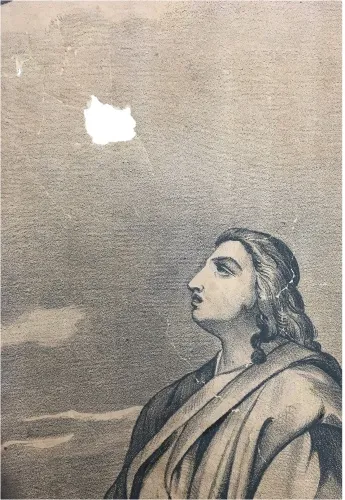
When part of a work is missing, the loss can be filled by adding a piece of paper, toned beforehand and cut to the exact shape of the gap.
Why fill?
A hole is not only visible: its edges are weak and grow with every handling. Filling strengthens the sheet and gives the image back its reading.
How
- I choose a paper close to the original in weight and texture, or use paper pulp for small losses.
- It is toned to the right shade, cut or cast to the exact shape of the loss, then adhered with starch paste.
- Retouching comes next: with a brush, watercolour or pencil, only on the filled area, never on the original.
How far to retouch?
That is a decision we take together. A retouch can stay discreetly visible up close, so the object’s history remains readable, or blend in completely for a work on display.
In the work
- Engraving on paper
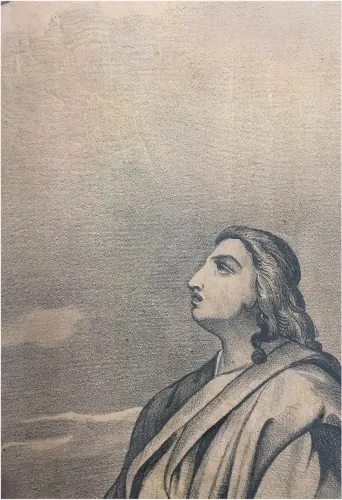
An engraving: filling a loss
A loss had opened in the sky of this engraving. Toned paper, cut to its exact shape, closes it.
- Work on paper
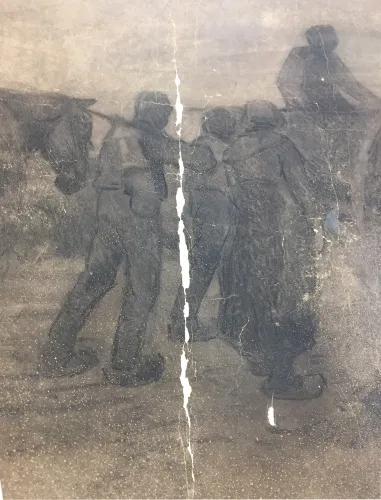
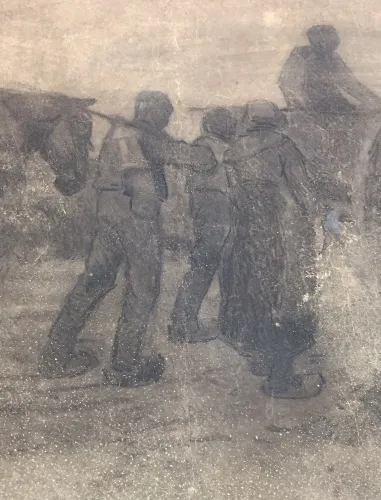
A scene of soldiers: tears and losses
Tears and white losses split the image in two. Filled and retouched, they no longer show.
- Drawing, contemporary work
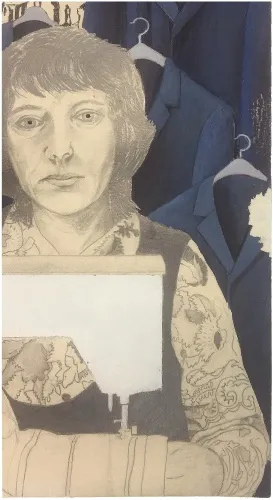
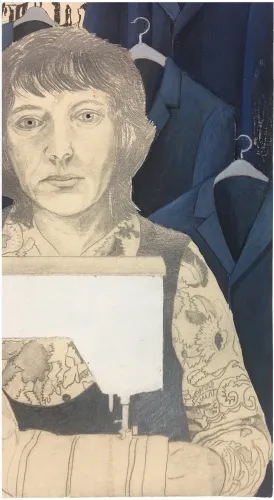
A contemporary portrait: losses in the background
White losses broke the background of this portrait. Filled and retouched, the background is continuous again.