Services
Water treatment / stain reduction
Reducing yellowing, foxing and tide lines with water: in a bath, a gel, a poultice or on damp blotting paper.
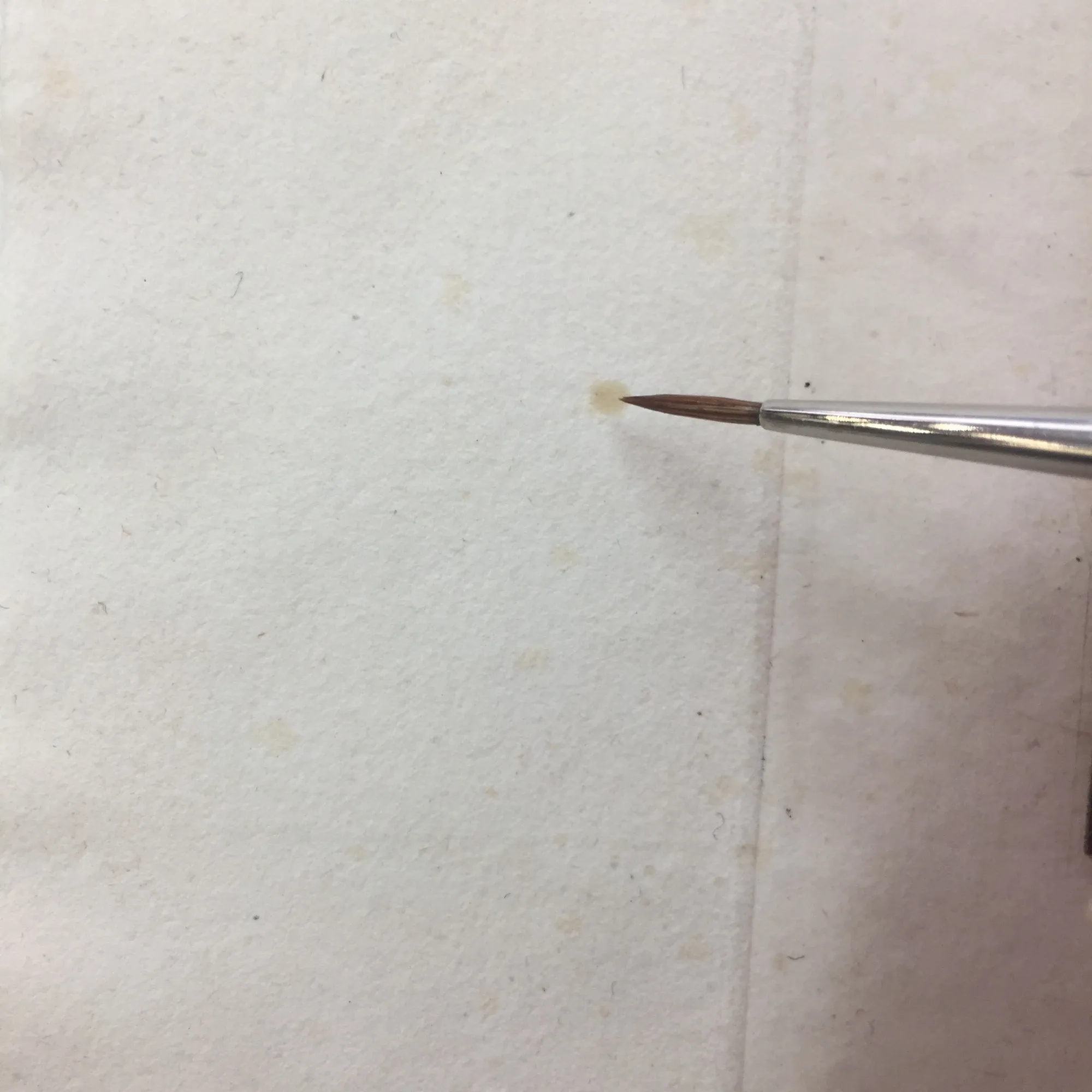
As it ages, paper can discolour in different ways: general yellowing, foxing (rust-coloured spots), tide lines. Water can be used in several ways to reduce these: baths, buffered solutions, gels, poultices or damp blotters.
Why water?
Much of what yellows and weakens paper dissolves in water: acidic products of cellulose degradation, old adhesive residue, dirt. Removing them lightens the sheet and slows its decay. My master’s thesis at La Cambre was about the chemistry of exactly this decay: the oxidation of cellulose.
A treatment that is prepared
- I first test every ink and colour for water sensitivity. An ink that bleeds rules out a bath.
- Depending on the work, I choose a full bath, a local treatment with a gel or poultice, or simple contact with a damp blotter.
- The water’s pH and temperature are controlled, and the sheet is dried under gentle pressure so it stays flat.
What to expect
A clear improvement, rarely a sheet that looks new. The aim is for the document to last, not to look freshly printed.